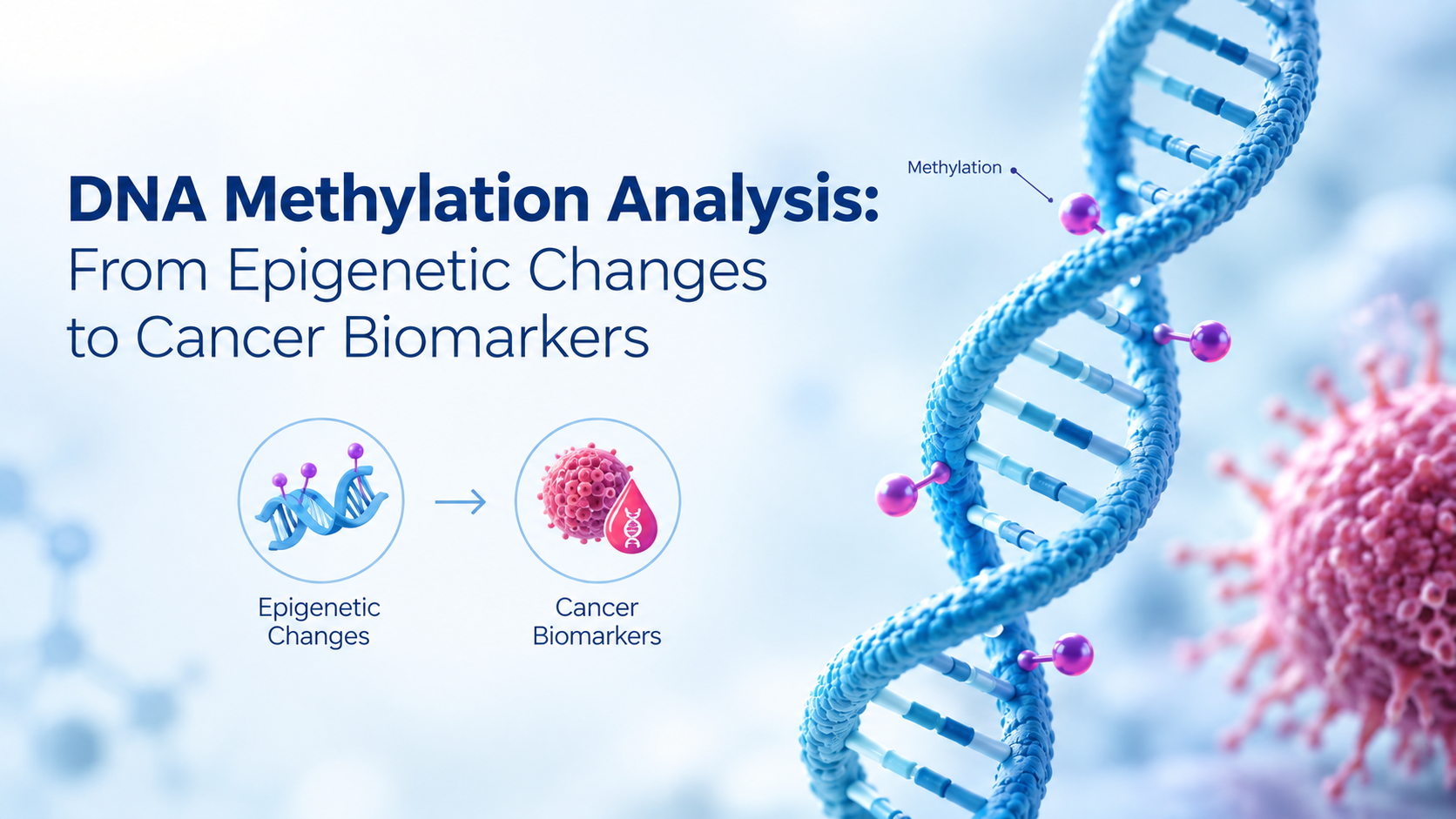
DNA Methylation Analysis: Methods, Applications, and Its Role in Cancer Research
DNA methylation analysis is a powerful molecular and epigenetic approach used to investigate chemical modifications of DNA that influence gene regulation without changing the underlying DNA sequence. Because abnormal DNA methylation is closely associated with cellular differentiation, aging, disease development, and cancer, methylation profiling has become an important tool in modern genomics, epigenomics, biomarker discovery, and precision medicine.
Recent advances have expanded DNA methylation analysis beyond conventional bisulfite-based methods. Technologies such as enzymatic methyl-sequencing, genome-wide methylation profiling, Oxford Nanopore sequencing, cell-free DNA (cfDNA) methylation analysis, and artificial intelligence-assisted interpretation are creating new opportunities for disease detection and molecular characterization.
In cancer research, particular attention is being given to methylation patterns in circulating cell-free DNA. These epigenetic signatures may provide information about the presence of cancer, tissue of origin, disease burden, treatment response, and potentially minimal residual disease.
What Is DNA Methylation?
DNA methylation is an epigenetic modification in which a methyl group is added to a DNA nucleotide without altering the DNA sequence itself. In mammalian genomes, the most extensively studied form is 5-methylcytosine (5mC), which commonly occurs at cytosine-phosphate-guanine sites, known as CpG sites.
DNA methylation can influence how genes are expressed by altering the regulatory environment surrounding genomic regions. For example, increased methylation within certain promoter regions is frequently associated with reduced transcription, although the biological relationship between methylation and gene expression depends on genomic context.
The human epigenome is dynamic rather than static. DNA methylation patterns can change during development, aging, environmental exposure, cellular differentiation, and disease.
In cancer, these alterations can become particularly profound. Tumor cells may exhibit both global hypomethylation and localized hypermethylation, resulting in changes to genome stability and the regulation of genes involved in cell proliferation, DNA repair, apoptosis, invasion, and immune responses.
Why Is DNA Methylation Analysis Important?
The DNA sequence alone does not completely explain how cells behave. Different cell types can contain essentially the same genome while displaying very different gene-expression patterns and biological functions.
DNA methylation contributes to this cellular identity.
Consequently, methylation patterns can provide information that cannot always be obtained from conventional DNA sequencing alone.
DNA methylation analysis is increasingly used to :
Identify epigenetic changes associated with disease
Study gene regulation
Discover and validate biomarkers
Characterize tumor biology
Investigate cancer development and progression
Determine tissue or cell of origin
Analyze circulating cell-free DNA
Monitor disease and treatment response
Investigate minimal residual disease
Support precision medicine research
Study aging and epigenetic changes
Investigate developmental and metabolic disorders
Importantly, methylation signatures can be highly tissue-specific. This characteristic is particularly valuable for analyzing cfDNA in blood because methylation patterns can help researchers infer the tissue or cell populations contributing DNA to the circulation.
DNA Methylation and Cancer
Cancer is one of the most important applications of DNA methylation analysis .
Cancer development is driven not only by genetic alterations but also by extensive epigenetic reprogramming. Aberrant DNA methylation can occur early during tumorigenesis and may affect genes involved in tumor suppression, DNA repair, cell-cycle regulation, and other cancer-related pathways.
Two broad patterns are commonly observed :
Global DNA Hypomethylation
Large portions of the cancer genome can become less methylated than their normal counterparts. Global hypomethylation may contribute to genomic instability and abnormal activation of certain genomic elements.
Localized DNA Hypermethylation
Specific genomic regions, particularly regulatory regions associated with tumor suppressor genes, can become abnormally methylated.
This may lead to transcriptional silencing of genes that normally contribute to controlling cell proliferation or maintaining genomic integrity.
The combination of these changes makes methylation patterns potentially useful as cancer biomarkers.

Major Methods for DNA Methylation Analysis
No single technology is optimal for every methylation study. The appropriate method depends on the research question, sample type, required resolution, genomic coverage, available DNA quantity, budget, and downstream analysis requirements.
The major approaches include:
1. Bisulfite sequencing
2. Methylation-specific PCR
3. Methylation microarrays
4. Enzymatic methyl-sequencing
5. Nanopore-based methylation sequencing
6. Targeted methylation sequencing
7. Cell-free DNA methylation profiling
Recent comparative studies have evaluated whole-genome bisulfite sequencing (WGBS), Illumina methylation arrays, enzymatic methyl-sequencing, and Oxford Nanopore sequencing, highlighting important differences in DNA requirements, coverage, bias, resolution, and analytical complexity.

1. Bisulfite Sequencing
Bisulfite sequencing has historically been considered the reference method for base-resolution DNA methylation analysis.
The principle is based on chemical conversion of unmethylated cytosines. Following bisulfite treatment, unmethylated cytosines are converted into uracil, while 5-methylcytosine is relatively resistant to conversion. Sequencing can therefore be used to infer the methylation status of individual cytosines.
Whole-Genome Bisulfite Sequencing
Whole-genome bisulfite sequencing (WGBS) provides genome-wide, single-base-resolution methylation information and remains one of the most comprehensive approaches for methylome analysis.
However, conventional bisulfite treatment has important limitations. The chemical process can damage and fragment DNA, which becomes particularly relevant when working with limited or degraded clinical samples such as FFPE tissue or circulating cfDNA.
These limitations have encouraged the development of alternative bisulfite-free approaches.
2. Methylation-Specific PCR
Methylation-specific PCR (MSP) is a targeted method designed to detect methylated or unmethylated DNA at specific genomic regions.
After bisulfite conversion, primer sets are designed to distinguish methylated from unmethylated sequences.
Quantitative approaches, including quantitative methylation-specific PCR (qMSP), can provide more quantitative information.
MSP is particularly useful when:
A specific biomarker has already been identified
A limited number of genomic loci need to be evaluated
High-throughput genome-wide profiling is unnecessary
Rapid targeted testing is required
Its major limitation is that it does not provide comprehensive genome-wide information.
3. DNA Methylation Microarrays
Microarray-based technologies allow researchers to investigate methylation at hundreds of thousands of genomic CpG sites simultaneously.
The Illumina Infinium MethylationEPIC array, for example, is widely used for epigenome-wide association studies and biomarker research.
Compared with WGBS, methylation arrays generally require less sequencing and can be more cost-effective for large cohorts.
However, arrays interrogate predefined genomic sites rather than every cytosine across the genome.
They are therefore particularly suitable when researchers need standardized, scalable methylation profiling across many samples.
4. Enzymatic Methyl-Sequencing
Enzymatic methyl-sequencing (EM-seq) has emerged as an important alternative to conventional bisulfite sequencing.
Instead of relying on harsh chemical conversion, enzymatic approaches distinguish methylated and unmethylated cytosines through enzyme-mediated reactions.
This can reduce DNA damage and improve the recovery of usable DNA molecules.
A recent comparative study using clinically relevant samples found that enzymatic methylation sequencing showed high concordance with bisulfite-based analysis while producing advantages in several sequencing metrics, including unique-read counts, DNA fragmentation, and library yield.
This is particularly relevant when sample quantity or DNA integrity is limited.
5. Nanopore Sequencing for DNA Methylation
One of the most important technological developments in methylation analysis is the ability to detect DNA modifications directly using long-read sequencing.
Oxford Nanopore sequencing can analyze native DNA without requiring bisulfite conversion. Methylated bases can be inferred from changes in the electrical signal generated as DNA passes through the nanopore.
This approach provides several potential advantages:
Direct analysis of native DNA
Long sequencing reads
Detection of methylation alongside sequence information
Reduced dependence on chemical conversion
Potential for haplotype-aware analysis
Ability to investigate complex genomic regions
Recent benchmarking work has continued to improve computational methods for nanopore-based methylation calling, including detection of 5-methylcytosine and methylation in non-CpG contexts.
However, nanopore methylation analysis also requires sophisticated computational pipelines, and performance can depend on sequencing depth, read quality, methylation abundance, basecalling, and the specific methylation-calling model used
6. Cell-Free DNA Methylation Analysis
One of the most rapidly developing applications of DNA methylation analysis is the study of cell-free DNA (cfDNA).
cfDNA consists of short DNA fragments circulating in biological fluids, particularly blood plasma. A fraction of circulating DNA can originate from diseased tissues, including tumors.
Because methylation patterns can retain information about tissue and cellular origin, researchers can analyze cfDNA methylation to identify disease-associated signatures without obtaining tissue through an invasive biopsy.
This has made cfDNA methylation a major component of modern liquid biopsy research.
A 2026 Nature Reviews Genetics perspective described DNA methylation as an increasingly important signal in liquid biopsy, particularly because tissue-of-origin information and epigenetic states can be encoded within circulating DNA.

How Is DNA Methylation Analysis Performed?
Although the workflow varies according to the technology, a typical methylation analysis pipeline includes several major stages.
Step 1: Sample Collection
Samples may include:
Blood
Plasma
Tumor tissue
FFPE tissue
Saliva
Urine
Other biological specimens
For liquid biopsy applications, plasma is commonly used for cfDNA analysis.
Step 2: DNA Extraction
High-quality DNA extraction is essential.
For cfDNA studies, the available DNA quantity may be extremely low, making extraction efficiency and contamination control particularly important.
Step 3: DNA Quality Assessment
DNA concentration, integrity, and purity are assessed before library preparation.
The quality-control requirements depend on the selected methylation platform.
Step 4: Methylation Detection or Conversion
Depending on the technology, DNA may undergo:
Bisulfite conversion
Enzymatic conversion
Direct nanopore sequencing
Targeted enrichment
Array-based hybridization
Step 5: Library Preparation
For sequencing-based approaches, the DNA is converted into sequencing libraries using a platform-specific workflow.
Step 6: Sequencing or Array Scanning
The samples are analyzed using the selected platform.
Step 7: Bioinformatics Processing
Raw data undergo:
Quality control
Adapter trimming
Alignment
Methylation calling
Coverage assessment
Normalization
Differential methylation analysis
Annotation
Statistical analysis
Step 8: Biological Interpretation
Differentially methylated positions or regions can then be mapped to:
Genes
Promoters
Enhancers
CpG islands
CpG shores
Regulatory regions
Cancer-related pathways
This final stage transforms methylation data into biologically meaningful information.
Differential DNA Methylation Analysis
A major objective of methylation studies is to identify genomic regions that differ significantly between groups.
Researchers may compare:
Tumor vs. normal tissue
Cancer patients vs. healthy controls
Responders vs. non-responders
Pre-treatment vs. post-treatment samples
Different cancer subtypes
Different disease stages
Results may be reported as:
Differentially methylated positions (DMPs)
Differentially methylated regions (DMRs)
Methylation levels or beta values
Methylation haplotypes
Genome-wide methylation signatures
Statistical analysis must account for multiple testing, sample heterogeneity, batch effects, cellular composition, and other potential confounders.
This is especially important in blood-based studies because cfDNA can originate from multiple tissues and cell populations.
DNA Methylation Analysis in Breast Cancer
Breast cancer is an especially important area for methylation research.
Aberrant methylation can be associated with tumor development, molecular subtype, disease progression, and treatment response.
Importantly, recent research has moved beyond methylation analysis of tumor tissue toward circulating cell-free DNA methylation profiling.
A 2026 study reported that cfDNA methylation profiling could distinguish advanced breast cancer from controls and was also investigated for classification of estrogen receptor status.
Another 2026 systematic review and meta-analysis evaluated circulating cfDNA and ctDNA biomarkers in breast cancer and found promising diagnostic performance for methylation-based assays, while also emphasizing substantial heterogeneity and the need for prospective standardized studies.
These findings illustrate both the promise and the current limitations of methylation-based liquid biopsy.
DNA Methylation and Early Cancer Detection
Early cancer detection is one of the most exciting applications of methylation analysis.
A major challenge in early-stage cancer is the extremely low concentration of tumor-derived DNA in the bloodstream.
Traditional mutation-based assays may struggle when only a small fraction of circulating DNA originates from the tumor.
Methylation can provide a complementary signal because cancer-associated epigenetic alterations can affect many genomic regions simultaneously.
Consequently, researchers are developing methylation-based multi-cancer early detection (MCED) approaches.
The National Cancer Institute currently supports research investigating genome-wide cfDNA methylome profiling for detection of multiple cancer types and evaluation of minimal residual disease.
Recent NIH-funded work has also focused on cost-effective cfDNA methylome sequencing technologies for multi-cancer detection. A 2026 publication described the use of a high-throughput cfDNA methylome approach in more than 1,000 individuals across several clinical applications.
Nevertheless, methylation-based blood tests should not be interpreted as a replacement for established diagnostic procedures unless they have been appropriately clinically validated and approved for the intended use.
DNA Methylation and Minimal Residual Disease
Another rapidly developing application is minimal residual disease (MRD) detection.
After treatment, a patient may have a very small population of residual cancer cells that cannot yet be detected using conventional imaging.
If these cells release tumor-derived DNA into the bloodstream, methylation signatures may potentially provide an early molecular signal.
This is particularly relevant to breast cancer.
In July 2026, researchers reported MammaTrace, a tumor-naïve, plasma-based cfDNA methylation assay being investigated for minimal residual disease surveillance in breast cancer.
Such approaches are still part of an evolving translational field, but they demonstrate how DNA methylation is moving from basic epigenetic research toward clinically relevant applications.
DNA Methylation, Artificial Intelligence, and Machine Learning
The scale of modern methylome datasets creates an important role for computational biology and artificial intelligence.
Machine learning models can analyze thousands or millions of methylation features simultaneously and identify combinations of genomic signals associated with disease.
Potential applications include:
Cancer classification
Tissue-of-origin prediction
Risk prediction
Disease subtyping
Treatment response prediction
Recurrence prediction
MRD detection
A 2026 study investigated the integration of DNA methylation biomarkers with artificial intelligence for breast cancer risk prediction, illustrating the increasing convergence of epigenomics and machine learning.
However, AI-based methylation models require careful validation.
A model may perform well in a retrospective dataset but fail to generalize to different populations, laboratories, ethnic backgrounds, sample-processing protocols, or disease prevalence.
Recent research has specifically highlighted the importance of reducing demographic bias in cfDNA methylation-based cancer detection models.

Advantages of DNA Methylation Analysis
DNA methylation analysis offers several important advantages:
High Biological Relevance
Methylation is directly connected to gene regulation, cellular identity, and disease biology.
Tissue-Specific Information
Distinct methylation signatures can help identify the tissue or cell type contributing circulating DNA.
Compatibility With Liquid Biopsy
cfDNA methylation analysis can potentially provide molecular information using minimally invasive blood samples.
Genome-Wide Profiling
Technologies such as WGBS, EM-seq, and nanopore sequencing can provide broad methylome information.
Biomarker Discovery
Disease-associated methylation patterns can be investigated as potential diagnostic, prognostic, or predictive biomarkers.
Integration With Multi-Omics
Methylation data can be combined with:
Whole-genome sequencing
Whole-exome sequencing
RNA sequencing
Transcriptomics
Chromatin accessibility
Proteomics
cfDNA fragmentomics
This integrated approach can provide a more comprehensive understanding of disease biology.
Limitations and Challenges
Despite its potential, DNA methylation analysis has several challenges.
Sample Quality
DNA degradation and low DNA input can substantially affect results, particularly in cfDNA and FFPE samples.
Technical Bias
Different platforms can produce different methylation measurements. Bisulfite conversion, GC bias, PCR amplification, sequencing depth, and alignment can all influence downstream results.
Biological Heterogeneity
A blood sample contains DNA from multiple cell types. Without appropriate computational correction, methylation differences may reflect changes in cellular composition rather than disease-specific alterations.
Standardization
Differences in sample collection, DNA extraction, library preparation, sequencing, data processing, and statistical analysis can make cross-study comparisons difficult.
Clinical Validation
A methylation signature discovered in a research cohort is not automatically a clinically validated biomarker.
Large, prospective, diverse, and independently validated studies are required before a methylation assay can be reliably incorporated into routine clinical decision-making.
The Future of DNA Methylation Analysis
The field is rapidly moving toward more comprehensive and clinically informative methylome analysis.
Several trends are particularly important:
Bisulfite-Free Methylation Sequencing
Enzymatic methods are increasingly attractive because they can reduce the DNA damage associated with conventional bisulfite conversion.
Direct Long-Read Methylation Detection
Nanopore sequencing enables direct analysis of native DNA and can combine sequence variation, methylation, and long-range genomic information.
cfDNA Methylome Profiling
Blood-based methylation analysis is becoming a major research direction for cancer detection, monitoring, and tissue-of-origin analysis.
Multi-Modal Liquid Biopsy
Future assays may combine:
DNA mutations
DNA methylation
Fragmentomics
Copy-number alterations
Nucleosome positioning
Protein biomarkers
rather than relying on a single molecular signal.
Artificial Intelligence
Machine learning may improve the ability to identify complex methylation signatures that are difficult to recognize using conventional statistical approaches.
Personalized Epigenomic Medicine
As methylation profiles become more deeply characterized, they may contribute to individualized approaches to cancer risk assessment, treatment monitoring, and disease surveillance.
Conclusion
DNA methylation analysis has evolved from a specialized epigenetics research technique into an increasingly important component of modern molecular biology and cancer research.
Traditional approaches such as bisulfite sequencing and methylation-specific PCR remain valuable, while newer technologies—including enzymatic methyl-sequencing, nanopore sequencing, and cfDNA methylome profiling—are expanding the scope of methylation analysis.
The greatest clinical potential may lie in liquid biopsy, where methylation signatures in circulating DNA can provide information about cancer presence, tissue of origin, molecular characteristics, disease burden, and potentially minimal residual disease.
For breast cancer and other malignancies, recent 2026 research demonstrates growing interest in cfDNA methylation for detection, molecular classification, risk assessment, and treatment surveillance. However, promising research findings should be distinguished from clinically validated diagnostic tests.
As sequencing technologies, computational methods, artificial intelligence, and multi-omics integration continue to advance, DNA methylation analysis is likely to become an increasingly important component of precision oncology, biomarker discovery, and non-invasive molecular diagnostics.
Frequently Asked Questions About DNA Methylation Analysis
What is DNA methylation analysis?
DNA methylation analysis is the study of methyl groups attached to DNA, particularly 5-methylcytosine at CpG sites, to identify epigenetic patterns associated with gene regulation, cellular identity, aging, and disease.
What is DNA methylation used for?
DNA methylation analysis is used in epigenetic research, cancer biomarker discovery, disease classification, tissue-of-origin analysis, liquid biopsy research, and studies of treatment response and minimal residual disease.
What is the most common method for DNA methylation analysis?
Bisulfite-based sequencing has historically been one of the most widely used approaches because it enables base-resolution methylation profiling. Newer enzymatic and direct long-read approaches are increasingly important alternatives.
Can DNA methylation detect cancer?
Research indicates that cancer-associated methylation patterns can be detected in tumor tissue and circulating cell-free DNA. However, a research biomarker should not automatically be considered a clinically validated cancer diagnostic test.
Can DNA methylation analysis be performed on blood?
Yes. Circulating cell-free DNA extracted from plasma can be analyzed for methylation patterns. This approach is an active area of liquid biopsy and cancer biomarker research.
What is the difference between DNA methylation and a genetic mutation?
A genetic mutation changes the DNA sequence itself. DNA methylation is an epigenetic modification that changes how genomic regions may be regulated without changing the underlying nucleotide sequence.
Why is DNA methylation important in breast cancer?
Abnormal methylation patterns are associated with breast cancer biology and are being investigated for cancer detection, molecular classification, risk assessment, treatment monitoring, and minimal residual disease detection.
گفتوگو درباره این مقاله
۰ دیدگاهتجربه یا پرسش خود را محترمانه و بدون اطلاعات پزشکی محرمانه بنویسید.
هنوز دیدگاهی ثبت نشده است؛ آغازگر گفتوگو باشید.